The decision for a breast augmentation is much more than a question of cup size – it is a choice between two fundamental surgical philosophies. While the proven standards offer maximum adaptability, the minimally invasive technique revolutionises the preservation of tissue and recovery time. Do you choose the surgical precision of the classic method or the quick recovery of the modern technique? Find out which path in 2026 truly fits your individual safety requirements and aesthetic goals.
In brief: Motiva Preservé™ vs. classic breast surgery compared
Minimally invasive
The Motiva Preservé™ technique shortens the duration of the operation to only approx. 30 minutes and uses micro-incisions of only 2–2.5 cm. The tissue is stretched in a controlled way instead of being cut over a large area, as in the classic procedure.
Quick recovery
Thanks to the innovative No-Touch technique and the option of local anaesthesia, female patients are often fully able to return to daily life after just 1–2 days. Classic methods usually require a week of recovery and an overnight stay in the clinic.
Increased safety
Through the consistent preservation of natural supporting structures and nerves, the Preservé™ method reduces the risk of
“True aesthetic achievement means not only a perfect visual result, but also a path to it that respects your anatomy to the greatest possible extent and ensures your safety by means of the most modern, tissue-sparing innovations.”
Motiva Preservé™ vs. classic breast surgery – the methods compared
Breast augmentations are among the most requested aesthetic procedures. A clear shift is visible in the market: many women want a beautiful result, but at the same time the need for a procedure that is as gentle as possible with a short recovery time is growing. This is precisely what Motiva Preservé™ responds to: a minimally invasive, tissue-sparing technique that deliberately sets itself apart from classic breast surgery.
The most important point first: it is not about “good” versus “bad”. It is about two surgical philosophies that prioritise different goals. One method focuses on maximum variability and proven standards (classic breast surgery). The other focuses on preserving tissue, small incisions and a quick recovery (Motiva Preservé™). Which method suits you depends less on trends and more on your anatomy, your desired result and your safety requirements.
What is Motiva Preservé™?
Motiva Preservé™ is a new, minimally invasive technique for breast augmentation. The essence: the implant is inserted through a small incision of about 2–2.5 cm in the breast fold. Instead of cutting or detaching tissue on a large scale, it is stretched in a controlled way. As a result, supporting structures and nerves more often remain intact – a decisive factor if you value sensation and a swift recovery.
Another important element is the No-Touch technique: the implant is placed in such a way that direct contact with the skin is kept to a minimum. The aim is clear: to lower the risk of infection, make the placement more precise and irritate the tissue as little as possible.
Another characteristic of Preservé™ is the use of Ergonomix2® implants. These implants are designed to adapt to your body posture, which is why they are often perceived as particularly natural – both visually and in the way they ‘move along’.
Incision
approx. 2–2.5 cm in the breast fold
Duration of surgery
approx. 30–45 minutes
Anaesthesia
Local anaesthesia / sedation (twilight sedation)
Daily life
often possible again after 1–2 days
Aim
preservation of tissue, minimal scarring, natural appearance, lower risk of capsular contracture/displacement of the implant
What does classic breast surgery involve?
In classic breast augmentation, the space for the implant (the pocket) is usually prepared by cutting free and detaching tissue. This is the big difference: the pocket is usually created by more extensive preparation, which gives the surgeon a lot of control, but also places a greater strain on the tissue.
The operation usually takes 60–90 minutes, takes place under general anaesthesia and often requires one overnight stay in the clinic. Because the procedure is more invasive, the recovery period usually takes longer: allow 5–7 days before you can resume your daily social activities. Exercise is often only advisable again after 4–6 weeks.
The length of the incision is also greater by comparison: often 4–6 cm. This makes it more likely that scars are more clearly visible – depending in part on your skin type, wound healing and aftercare.
Incision
often 4–6 cm
Duration of surgery
approx. 60–90 minutes
Anaesthesia
general anaesthesia
Clinic
often 1 overnight stay
Daily life/exercise
daily activities after 5–7 days, exercise usually after 4–6 weeks
Risks
generally higher (e.g. capsular contracture, infection, rupture, displacement), pain often more severe
Expertise & safety: your journey at QUOLE Aesthetics
The choice between Motiva Preservé™ and the classic method is a decision for your satisfaction in the long term. At QUOLE Aesthetics, our responsibility does not end with the operation. We guide you through a structured and careful aftercare programme – from the initial healing to the final formation of the result.
Our plastic surgeons combine the most modern techniques with individual care to guarantee your aesthetic results and safety in 2026.
Take the next step. Make an appointment now for your personal consultation at QUOLE Aesthetics and find out which method fits your anatomy and lifestyle perfectly.
Motiva Preservé™ vs. classic breast surgery: the direct comparison
So that you do not have to choose on the basis of gut feeling or opinions on forums, we offer you a clear overview of the facts. The most important differences lie in the tissue trauma, the anaesthesia, the size of the incision, the recovery time and the risk profile.
Criterion
Motiva Preservé™
Classic breast surgery
Duration of surgery
approx. 30–45 min
60–90 min
Anaesthesia
Local anaesthesia / sedation (twilight sedation)
General anaesthesia
Incision length
2–2.5 cm
4–6 cm
Tissue preservation
Tissue is stretched, structures more often remain intact
Make an appointment: your path to the ideal breast augmentation
At Quole Aesthetics Eindhoven you have the choice: maximum tissue preservation through Motiva Preservé™ or complete adaptability through the classic operation. We analyse your anatomy and find the technique that fits seamlessly into your daily life.
Our plastic surgeons guide you from the first measurements to the final check of the healing. We discuss all the details about the incision, the sports bra and physical strain, so that you feel completely confident about your decision.
Start today: Make an appointment for your personal consultation and let us plan your optimal result together.
Which method is suitable for whom?
Here we distinguish between theory and real surgical planning. Not every anatomy is automatically suited to the minimally invasive route – and conversely, the classic operation is not automatically “too much”. Decisive are your goal, the quality of the tissue, the breast base and the starting shape.
Motiva Preservé™ is often the best choice if you…
Want a subtle breast augmentation that places as little strain on your body as possible. This is often the case if you want more volume again after a pregnancy or weight loss, but cannot or do not want to plan a long recovery time. Also if you want to avoid general anaesthesia, Preservé™ is an attractive option, because the procedure is usually possible under local anaesthesia with twilight sedation.
In practice, the combination of a small scar, faster recovery and the feeling that the result moves naturally with the body, rather than feeling like a rigid element, is often convincing.
Classic breast surgery is often advantageous if you…
Want more volume, have a more complex breast shape or if a correction requires considerably more surgical shaping. As soon as the placement of the implant or the correction of asymmetry has to be controlled very precisely across several levels, classic methods often offer more possibilities. This also applies when the starting situation is very slim or there is little natural tissue available to cover the implant.
In short: Preservé™ is strong when “gentle and quick” is realistic. Classic is strong when “maximum adaptability and versatility” are necessary.
Risks: what are the real differences – and what are not?
Regardless of the method you choose: a breast augmentation remains a surgical procedure. Basic risks such as swelling, bruising, wound healing disorders or infections are in principle always possible.
The difference lies mainly in the likelihood and dynamics of certain aspects:
With Preservé™, the tissue is prepared less invasively. This can mean that swelling and discomfort are less intense and the recovery is ‘calmer’.
The combination of tissue-sparing pocket formation and the No-Touch principle is aimed at minimising the risk of infections and capsular contracture.
With classic operations, the preparation is more extensive. As a result, the pain can be more severe and certain risks (such as capsular contracture or displacement of the implant) occur more often – not because the method is ‘worse’, but because more tissue is worked on and the procedure as a whole is more invasive.
Important: your individual risk is determined not only by the method, but also by the choice of implant, the planning of the operation, the aftercare, the quality of your tissue and your personal healing process.
The recovery process: what you can realistically plan for
Many decisions are ultimately influenced by one factor: daily life. Anyone who looks after children, does physically heavy work or has to get back to work quickly assesses the recovery time differently from someone who can easily plan several weeks of rest.
With Motiva Preservé™, recovery is often faster: many female patients feel able to take up their daily activities again after 1–2 days. Exercise is generally possible again from week 2–3 – with care, of course, and depending on how the recovery goes.
With classic breast augmentation, the recovery time is usually longer: 5–7 days is often the phase in which you really function ‘normally’ again without every movement being sensitive. Exercise is usually only an option again after 4–6 weeks, depending on the placement of the implant and the physical strain.
What applies in both cases: the final shape and ‘settling’ of the breast develop over a period of several weeks. At first the breast may feel higher and firmer and will only settle step by step into its natural position.
Costs: why Preservé™ is often higher – and why that is not the whole story
You may have come across a guide price from €9,800. This can serve as a rough orientation, but never replaces an individual calculation. In practice, the final price depends mainly on the following points:
Type of implant and the desired size
Form of anaesthesia (local anaesthesia/sedation vs. general anaesthesia)
Duration of surgery and the complexity of the pocket formation
An honest comparison does not look only at the price, but also at what you ‘get with it’: the recovery time, the comfort, the intensity of the aftercare and the safety concept.
Conclusion: which method suits you?
Motiva Preservé™ stands for a modern, tissue-sparing breast augmentation with a small incision (2–2.5 cm), a short duration of surgery (approx. 30 minutes) and an often quick return to daily life (1–2 days). The method is aimed at preserving sensation and supporting structures as far as possible and at reducing risks such as capsular contracture or displacement of the implant.
Classic breast surgery remains the right option when the starting situation calls for more surgical shaping: for larger volume wishes, more complex breast shapes, corrections or situations in which more extensive preparation is simply necessary. In that case you should expect general anaesthesia, a longer duration of surgery (60–90 minutes) and a longer recovery period.
If you want clarity, in the end no comparison on the internet counts, but the question: what is realistic for your anatomy – and which method takes you to your goal with the least risk? Dr. Frank Gruner of QUOLE Aesthetics will discuss this with you during a personal consultation – with an eye for shape, safety and a recovery that suits your life.
Frequently asked questions
Is the Motiva Preservé™ method painful?
Many female patients experience Preservé™ as less burdensome, because the tissue is not cut over a large area but stretched in a controlled way. This does not mean that you feel nothing at all, but the start is often ‘lighter’ than with a classic operation, especially when the pectoral muscle is less intensively involved.
How long does the result stay beautiful?
Breast implants are not a decision for eternity, but an early exchange is certainly not automatic either. Regular check-ups, the reaction of your tissue, the type of implant and individual factors are decisive. During the consultation we discuss how you can check over the long term that everything remains stable.
Is breastfeeding still possible afterwards?
In principle, this depends on the incision, the placement of the implant and your starting anatomy. With tissue-sparing methods, the preservation of the natural structures is often seen as an advantage. However, specific advice can only be given after a personal examination and planning.
How visible are the scars really?
With Preservé™, the incision is very small and is located in the breast fold, which often leads to very inconspicuous scars. With the classic operation, the incision is longer, so scars may be somewhat more visible. Factors such as skin type, aftercare and your personal tendency to scarring also play a major role here.
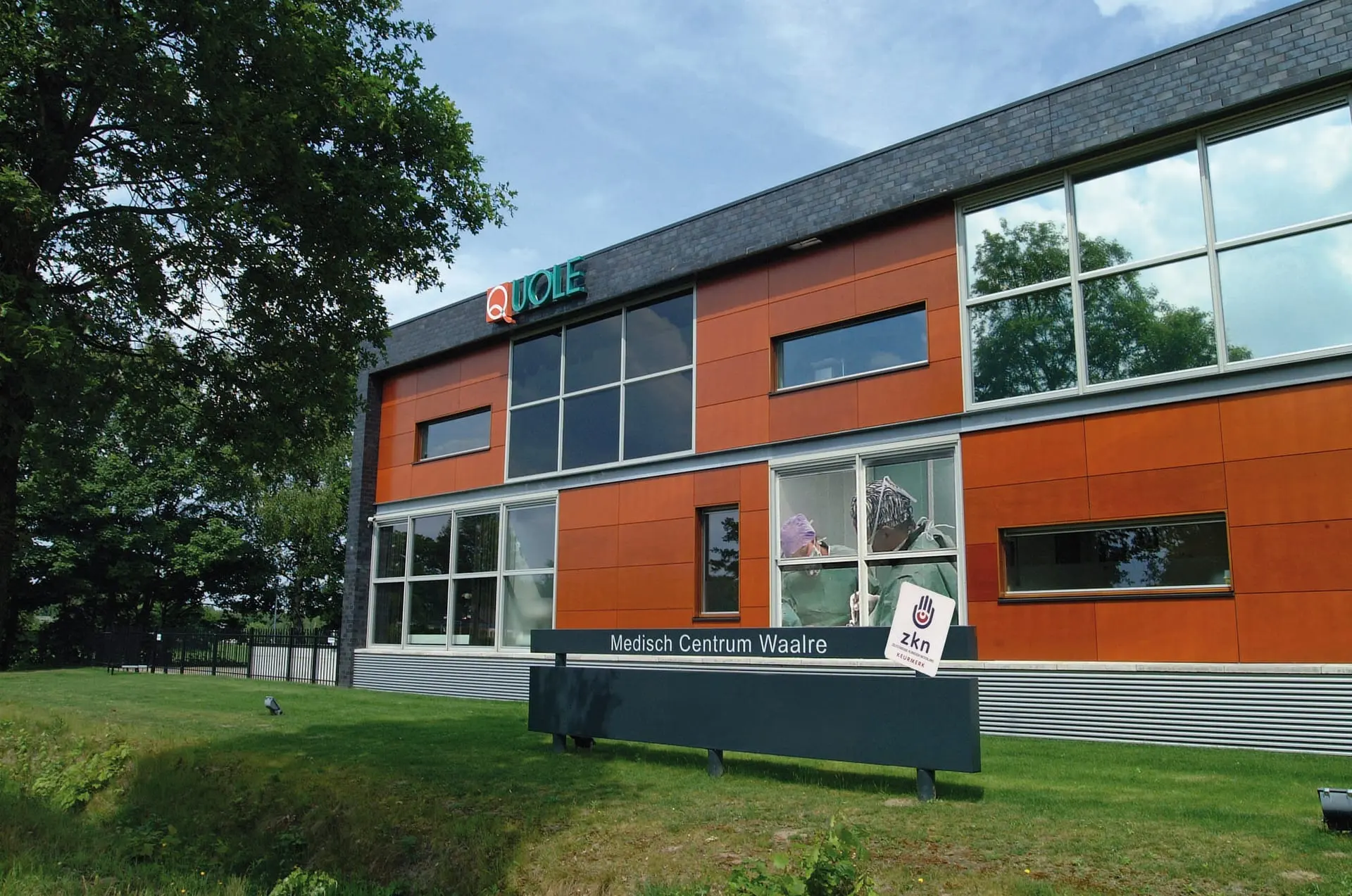
The building
Your treatment in Waalre.
Medisch Centrum Waalre, Van Dijklaan 9 in Waalre, just south of Eindhoven. Easy to reach from Eindhoven, Veldhoven, Valkenswaard, Geldrop and Heeze.
Had a breast reduction in October 2024. I can only look back on it with praise. What a great surgeon, Dr H. Hawinkel, with a great team around him in every respect. Thank you all for the beautiful result, the care and the aftercare! You're all stars!
Breast reduction · August 2025 · ZorgkaartNederland
Had my balloon refilled last week. And, like the first time when it was placed, a very nice, friendly welcome. No tension at all because they treat you so kindly and properly.
Claudia B. · August 2025 · ProvenExpert
Came to Dr. Boons with knee problems. Through the clinic's arrangement, the imaging could be scheduled within a day. Dr. Boons's explanation was very clear and he took all the time it needed. Very satisfied!
Knee ligament injury · June 2025 · ZorgkaartNederland
A dermatologist looks, assesses and treats straight away. Doctor Debije does this promptly and so fully meets my expectations!
May 2025 · ZorgkaartNederland
I was able to get in at Quole very quickly to have suspicious spots removed. I was helped in an expert and pleasant way. The assistant also thought along well to schedule the appointments so that they fitted in with my work.
Skin cancer · May 2025 · ZorgkaartNederland
Very satisfied with the medical secretaries as well as the doctor and all the care staff in between. Everyone took my difficult situation very seriously and acted quickly. I really felt heard. Doctor Hawinkel is a nice doctor. Thank you all!
Plastic surgery · April 2025 · ZorgkaartNederland
After going round the Netherlands, I ended up, through word of mouth, with dermatologist Dr. Debeij at Quole. In a word: a super dermatologist. I have never been helped so well anywhere else. I am very grateful.
February 2025 · ZorgkaartNederland
Got an appointment with the doctor extremely quickly with the help of supporting staff. Helped pleasantly and quickly
Meniscus injury · January 2025 · ZorgkaartNederland
Nice and homely, relaxed. I don't feel like a number but really like a patient. Helped quickly and smoothly! No long waiting times like in hospitals
Meniscus injury · January 2025 · ZorgkaartNederland
Very satisfied! A good and competent clinic.
Knee ligament injury · October 2024 · ZorgkaartNederland
Good information beforehand and during. Short waiting time, coordination. Professional, expert and friendly delivery of care. Careful and personal aftercare.
September 2024 · ZorgkaartNederland
I was helped very well
Knee ligament injury · June 2024 · ZorgkaartNederland
I was helped very well, unfortunately had a lot of bad luck, had good contact every day. And the corrective operation is planned. Completely satisfied
Plastic surgery · May 2024 · ZorgkaartNederland
On 28 Sept 2023 I had my tummy tuck, Fleur de lis, done. Doctor Donders operated on me and how good this doctor is, an artist! Happy every day with my decision and the result. I was treated well from day 1, they listened to me and thought along with me. I was well informed about what would suit me best. Super lovely staff and the doctor. Everyone is lovely, friendly and helpful. Once again, thank you all for the good care. Would do it the same way again without a doubt. This clinic and doctor are highly recommended.
May 2024 · ZorgkaartNederland
Finally I ended up with a dermatologist who told me very well and explained what caused my problem. Fortunately, this dermatologist did help me well.
May 2024 · ZorgkaartNederland
From my first appointment I have been very, very satisfied, with friendly people, professional too. I'm glad I chose QUOLE Medisch Centrum Waalre, thank you
May 2024 · ZorgkaartNederland
Appointments were made easily, and they kept asking whether the doctor's explanation was clear. The care around the operating theatre was also very good. There was good aftercare in the recovery room. You are a person and not a number.
Knee ligament injury · April 2024 · ZorgkaartNederland
Very satisfied with the short waiting time and the friendliness.
Frozen shoulder · April 2024 · ZorgkaartNederland
The biggest plus of Medisch Centrum Waalre for me was the speed with which they were able to help me. I could only get a first appointment at a hospital after 6 weeks, but in Waalre I could come in after just 2 days, and I was even operated on here within those 6 weeks! Above all, save yourself time!
Knee ligament injury · March 2024 · ZorgkaartNederland
Very, very satisfied with the care I received. A personal approach, and at every moment they calmly take time for you.
February 2024 · ZorgkaartNederland
I went to Quole Medisch Centrum because of the dermatologist who has recently started working there. I used to go to this friendly and capable dermatologist before as well. As for Quole Medisch Centrum: a very beautiful building with presence, inside and out. Good service, friendly and no long waiting times. If you don't want to wait long, this medical centre is very good, with very capable doctors and staff working there. Recommended by a very satisfied patient.
Skin conditions · February 2024 · ZorgkaartNederland
I am very satisfied with dermatologist Debeij. A very skilled dermatologist who has always helped me really well. I was already going to this dermatologist when she still had her own clinic, because of less good experiences with other dermatologists. I have to drive a lot of km to get to Dr. Debeij, but it's worth it to me.
February 2024 · ZorgkaartNederland
Quole is a really nice medical centre. You are helped quickly and well looked after. The employees are all very kind!
Knee ligament injury · November 2023 · ZorgkaartNederland
Expert approach and solution to my problem. Super friendly and caring team of healthcare professionals.
Inguinal hernia · November 2023 · ZorgkaartNederland
All the staff around my hallux valgus operation radiate calm and friendliness. There is a relaxed and informal atmosphere in the clinic. You are understood and seen.
August 2023 · ZorgkaartNederland
Very fast, appropriate help and appointments that followed on well from one another. Top-notch organisation
Osteoarthritis · June 2023 · ZorgkaartNederland
Received clear information about the necessary treatment and the effect to be expected from it
May 2023 · ZorgkaartNederland
I was treated very well. They explained clearly what I could expect beforehand and also what to expect after the operation in terms of recovery.
Knee ligament injury · April 2023 · ZorgkaartNederland
As described in Quole's communication, you are treated as a guest. And that is true. The consultations, the operation itself and the aftercare were not only extremely professional but also very personal, friendly and unhurried. People with an eye and a genuinely listening ear both for your physical wishes/changes in appearance and for your state of mind (tension, fear, calm, self-confidence). Thanks to Dr. Donders for the clear advice, the plan and above all the beautiful result!
Breast augmentation · April 2023 · ZorgkaartNederland
The clinic's personal approach is very pleasant. You are treated not as a number but as a guest.
Knee ligament injury · March 2023 · ZorgkaartNederland
What a lovely clinic with friendly, professional care. There is a pleasant, caring atmosphere and Dr Hawinkels is a likeable, skilled plastic surgeon.
March 2023 · ZorgkaartNederland
They take me seriously
December 2022 · ZorgkaartNederland
The whole process went very well. Both beforehand during the intake consultation, and on the day of the operation and at the final consultation. The day after the operation, a member of staff kindly called me to ask whether everything had gone well and how I was doing. A small-scale, committed and very expert team. Compliments